
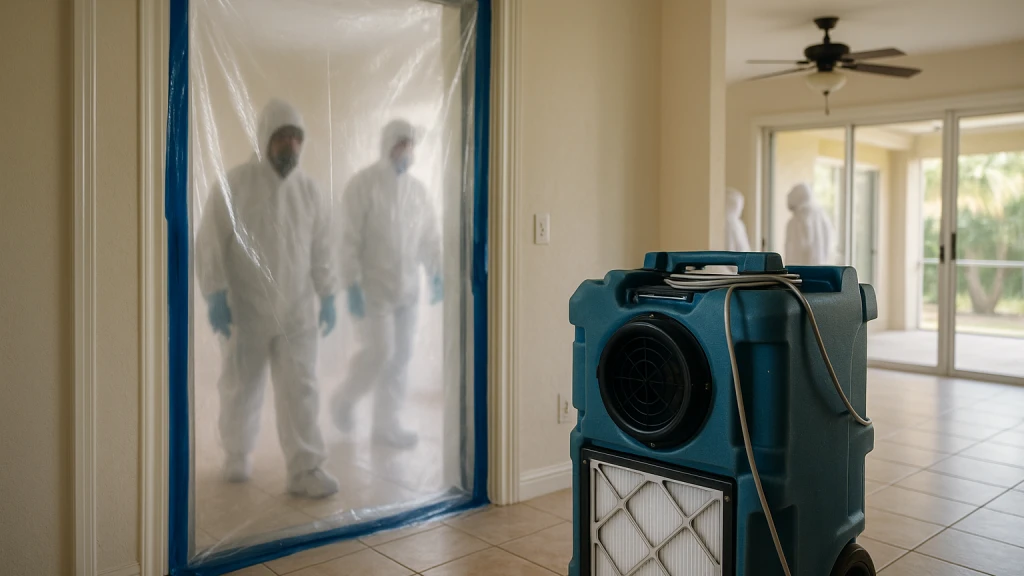
When mold becomes a whole-home problem
Most mold jobs are local — a bathroom, an attic, an AC closet. Whole-home remediation is different in kind, not just degree. It's what you need when moisture has affected multiple rooms or the building's structure, and in Central Florida there are a few classic ways a home gets there. A slab or supply-line leak that ran undetected for months wicks moisture across a large area of flooring and the bottoms of many walls. A home that sat vacant and unconditioned — a foreclosure, an inherited property, a snowbird's place, a rental between tenants — lets indoor humidity climb unchecked through a Florida summer until mold blooms on walls, ceilings, furniture, and contents throughout. And a major storm flood that was dried superficially but never to a verified standard can leave moisture trapped in wall cavities across the whole footprint.
The tell is that the musty smell is everywhere and the growth isn't confined to one obvious source. When that's the case, treating rooms in isolation tends to fail, because they share the same air, the same HVAC system, and often the same underlying moisture problem.
The vacant-house humidity trap
This deserves its own mention because it's so common in Osceola County, with its mix of rentals, vacation homes, and seasonal residents. A house in Florida needs its air conditioning — or at least a dehumidifier — running even when no one's home. Shut the AC off to save money for a few months, and indoor humidity rises to match the outdoors, condensation forms on cool interior surfaces, and mold establishes itself on drywall, baseboards, closets, leather, and stored belongings throughout the house. People return to a home that looks like it was flooded, except the water came out of the air. These cases are almost always whole-home jobs, and they're entirely preventable by keeping the home conditioned. Our humidity-control guide explains the settings that prevent it.
How a whole-home project is structured
A project this size starts with an independent assessment, because you can't scope a whole-home remediation by eye. A licensed assessor maps every affected area, identifies the moisture source or sources, and writes a remediation protocol with clearance criteria. From there, the remediation crew works through the home methodically:
- Source correction: finding and fixing every moisture input — leaks, the HVAC system, humidity control — before removal begins.
- Containment by zone: isolating work areas and protecting unaffected parts of the house, with the HVAC system managed so it doesn't spread spores.
- Removal: taking out unsalvageable porous materials room by room — drywall, insulation, flooring, and often contents.
- Treatment and drying: antimicrobial treatment of structural surfaces and sustained drying to a measured standard across the whole footprint.
- Clearance testing: independent verification that the home meets the cleanup standard before any rebuild.
Contents, HVAC, and the things people forget
Whole-home jobs raise issues that small ones don't. Belongings — furniture, clothing, documents, electronics — may need cleaning, off-site treatment, or disposal, and deciding what's salvageable is part of the work. The HVAC system almost always needs attention, because a system that ran while the house was moldy has spread spores through every duct and likely harbors growth itself; cleaning or replacing affected ductwork is frequently part of the scope. And the rebuild has to wait for verified dryness across the structure, not just the rooms that looked worst. A pro who treats the home as a connected system — air, HVAC, structure, and contents — produces a result that holds, where a piecemeal approach leaves pockets to regrow.
What whole-home remediation costs
There's no way around it: whole-home and structural projects are the expensive end of mold work, commonly landing in the $10,000–$30,000 range and sometimes beyond for large homes with extensive structural involvement, HVAC replacement, and contents handling. The number tracks the scope — how many rooms, how much porous material comes out, whether framing and subfloor are affected, and what the rebuild requires. That's exactly why the independent assessment matters so much here: it defines the real scope so you're pricing the actual problem, and it gives you a clearance standard to hold the work to. Our cost guide breaks down where the money goes, and the estimator can sketch a starting range.
Getting a large project under control
A whole-home mold situation feels overwhelming, but it's a solvable problem with a clear sequence: assess, correct the moisture, remediate by zone, dry to standard, and verify. The worst thing to do is nothing, because in this climate the moisture that caused it keeps working. If you're facing a multi-room problem, a home that sat closed up, or a flood that was never properly dried, tell us what's going on and we'll connect you with a licensed, independent local team that can assess the full scope and give you a real plan and a free, no-pressure quote.