
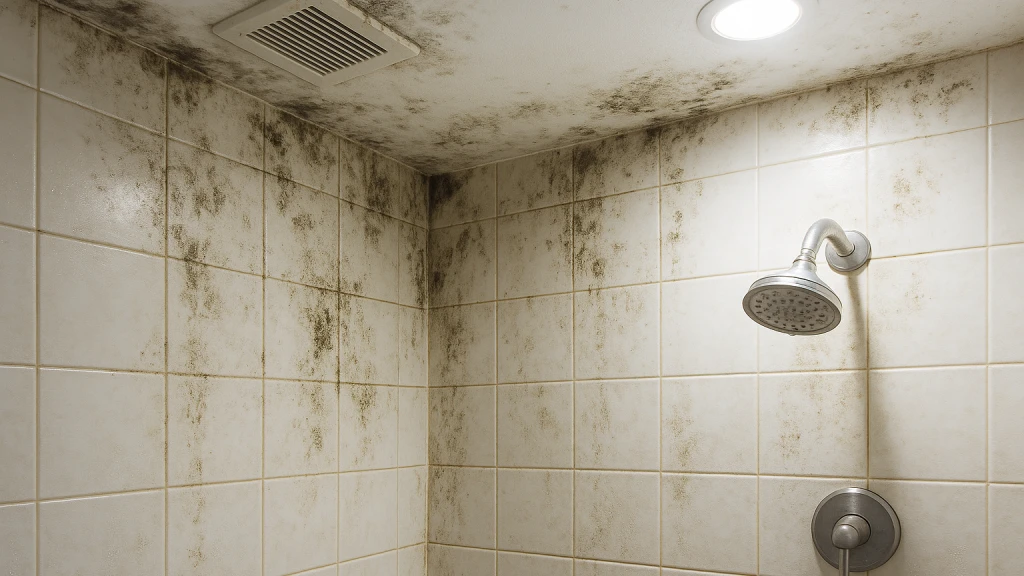
Why these rooms grow mold first
Kitchens and bathrooms combine the two things mold needs — moisture and organic material — in concentrated, daily doses. A hot shower can spike a small bathroom's humidity above 90% in minutes, and if the exhaust fan is weak, vented into the attic, or missing entirely, that moisture settles on the ceiling, the grout, and the wall behind the toilet. Under sinks, slow supply-line and drain drips keep the cabinet floor and the wall behind it damp in the dark, where you don't notice until the cabinet bottom swells or a musty smell appears. In Central Florida's baseline humidity, surfaces that would dry out quickly up north stay damp long enough to support growth, so the margin for error is smaller here.
The visible result is familiar: black speckling in the shower corners and along the ceiling, pinkish film on tile (often a bacteria, not mold, but a moisture signal all the same), and dark patches inside the vanity. Most of it is surface mildew on non-porous tile and can be cleaned. The cases that need real remediation are the ones where water has gotten into porous material — drywall, the cabinet box, the subfloor — and stayed there.
Surface mildew vs. a real moisture problem
Telling these apart saves money. Mildew on tile, grout, glass, and painted surfaces is a cleaning-and-ventilation issue: scrub it, improve airflow, and keep the surface dry, and it stays gone. A real moisture problem shows different signs — a spongy floor by the tub, drywall that's soft or stained from behind, a vanity bottom that's swollen and dark, a musty smell that persists after cleaning, or mold that keeps returning in the same spot within days. Those point to water inside the structure: a leaking shower pan, a drain joint that weeps, a toilet flange seeping at the floor, or a supply line dripping behind the wall. Cleaning the surface there is like mopping around a running faucet.
The leaks that hide behind the tile
- Failed shower pans and grout: water escaping a cracked pan or missing grout soaks the wall framing and subfloor around the shower — a leading cause of bathroom mold that's invisible from inside the stall.
- Under-sink drips: slow supply or drain leaks rot the cabinet and the drywall behind it in both kitchens and baths.
- Toilet flange and wax-ring leaks: a seeping toilet base wicks into the subfloor, producing mold and soft flooring around the toilet.
- Dishwasher and fridge-line leaks in kitchens, which spread under cabinets and flooring before they're noticed.
- Caulk and backsplash gaps at counters and tubs that let water reach the wall behind.
How remediation works in these rooms
When mold has reached porous materials, surface cleaning isn't enough. A licensed pro will find and stop the leak first, then remove the affected materials — a section of drywall, the soaked cabinet, damaged flooring or subfloor — under containment if the area is significant, treat the remaining framing, and dry everything to a measured standard before rebuilding. For contained spots, this is a focused, often one-to-two-day job. The key is that the moisture source is corrected as part of the work; otherwise you're rebuilding into the same wet conditions. For larger or chronic cases, an inspection first maps how far the water actually traveled, which is frequently farther than the visible stain suggests.
Ventilation: the bathroom fix people skip
The single most effective bathroom mold prevention is also the most ignored: a working exhaust fan that vents outside and runs long enough to clear the moisture. Many Kissimmee bathrooms have fans that are underpowered, clogged with dust, vented into the attic (which just relocates the problem and feeds attic mold), or never turned on. Running the fan during and for 20–30 minutes after every shower, wiping down the shower, and keeping the door open to circulate air can be the difference between a clean bathroom and a recurring mold spot — no remediation required. Our humidity-control guide covers the whole-home version of this.
What it costs
Surface mildew is essentially free to handle yourself. A contained remediation — removing a wet section of drywall and a damaged vanity, treating, and drying — is a modest job, typically in the hundreds to low thousands depending on how much material is involved and whether flooring or subfloor is affected. The number jumps when a long-running hidden leak has spread into the subfloor or an adjacent room, which is exactly why catching a bathroom or kitchen leak early is worth it. Sketch a range on our cost estimator, and if you're unsure whether your situation is a wipe-down or a real remediation, tell us what you're seeing and we'll connect you with a licensed local pro to take a look.