
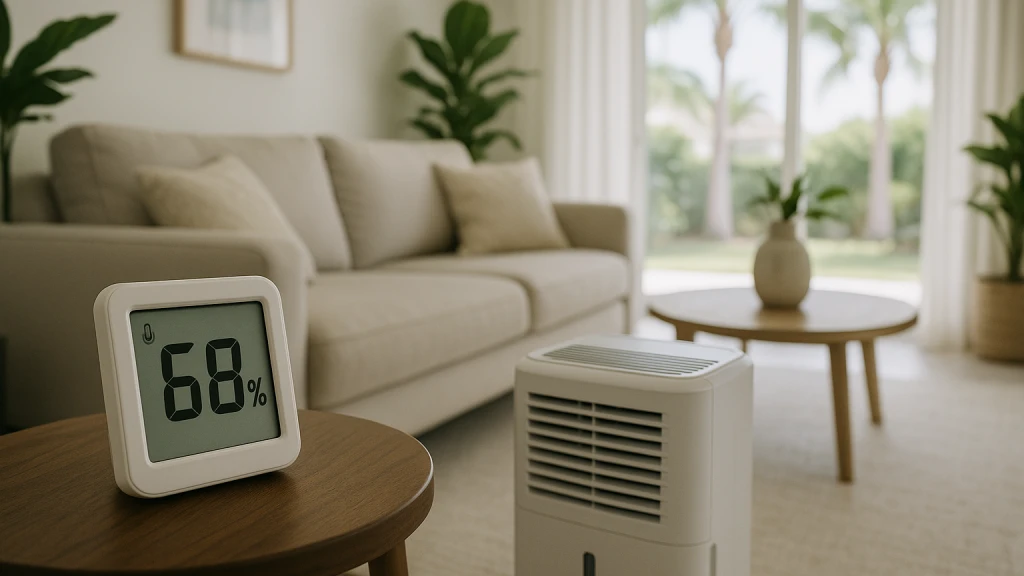
The number that matters: 55%
Mold prevention in Florida really does come down to a single target. Keep indoor relative humidity below about 55%, and mold struggles to establish even in a warm home full of the cellulose it feeds on. Let it climb above 60–65% for sustained periods — which happens easily here — and you've created the conditions for growth on walls, in closets, on furniture, and around vents, no leak required. The first practical step for any homeowner is simply to measure: a cheap digital hygrometer (under $20) tells you where your home actually sits, and many smart thermostats display it too. You can't manage humidity you're not watching, and a lot of Kissimmee homeowners are surprised to find their “cool” house is sitting at 60%+ humidity.
Your AC is your primary dehumidifier
In most Florida homes, the air conditioner does the heavy lifting on humidity, so how it runs matters enormously. A few things help it dehumidify well: making sure it's correctly sized (an oversized unit cools too fast to remove moisture — a real and common problem), setting the fan to “auto” rather than “on” (continuous fan re-evaporates moisture off the coil back into the house), and keeping the system maintained so the coil and condensate drain work properly. Setting the thermostat reasonably — not so cold the system short-cycles, not so warm it barely runs — helps too. If your AC keeps the house cold but clammy, that's the signature of a system that's cooling without dehumidifying, and it's worth having a pro evaluate the sizing and setup. Our AC and HVAC page covers the mechanics.
When you need a dehumidifier
Sometimes the AC alone isn't enough, and a dedicated dehumidifier earns its place. That's especially true in homes with an oversized AC that won't dehumidify well, in vacant or seasonally occupied homes, in damp spots like closets or a Florida room, and during the mildest weather — spring and fall — when the AC doesn't run enough to pull humidity but the air is still damp. A portable unit handles a room or a problem area; a whole-home dehumidifier tied into the HVAC handles the entire house and is a strong option for vacation rentals and homes that struggle with humidity year-round. The goal is the same either way: hold that under-55% target consistently.
Ventilation: move the moisture out
- Bathroom fans: run an exhaust fan that vents outside (not into the attic) during and for 20–30 minutes after every shower — the most impactful single habit in most homes.
- Dryer venting: make sure the clothes dryer vents fully outside; a disconnected or attic-vented dryer dumps enormous moisture indoors.
- Kitchen: use the range hood when cooking, especially boiling, to remove steam.
- Air circulation: keep closet doors cracked and furniture slightly off exterior walls so humid air doesn't stagnate against cool surfaces.
The vacant-home rule
This one deserves its own section because it causes some of the worst mold cases in Osceola County. A Florida home left without its AC or a dehumidifier running — a rental between tenants, a snowbird's place, a vacation home between bookings — will grow mold from humidity alone, sometimes blooming through the entire house in a matter of weeks. The fix is simple and cheap: never shut the climate control off entirely. Set a smart thermostat to hold around 76–78°F with humidity control, or run a whole-home dehumidifier, whenever the home is empty. The energy cost of keeping a vacant home conditioned is trivial next to the cost of remediating a whole-home humidity bloom. For rental and vacation-home owners, remote-monitoring thermostats and humidity sensors are worth every penny.
A simple Kissimmee humidity routine
Put together, here's what keeping a Central Florida home dry looks like: measure your humidity and aim under 55%; run an AC that's sized and maintained to dehumidify, with the fan on auto; add a dehumidifier where the AC can't keep up; vent bathrooms, the dryer, and the kitchen outside; keep air moving so it doesn't stagnate on cool surfaces; never leave the home unconditioned; and fix any leak immediately, because in this climate a wet material dries slowly. Do that, and you've removed the moisture mold depends on. If your home is staying humid no matter what you try, something specific is driving it — tell us what you're seeing and we'll connect you with a licensed local pro who can find it.