Why testing matters more in Central Florida
In a humid climate like Kissimmee's, the question is rarely “is there any mold in the air?” — there always is, indoors and out, because mold spores are a normal part of Florida's environment. The real questions are whether there's active growth inside your home, what's feeding it, and how far it has spread inside walls, ceilings, and the air-handler closet where you can't see. A good inspection answers those questions with evidence instead of guesswork, so you don't pay to remediate a stain that's actually harmless surface dust, and you don't ignore a hidden colony that's quietly spreading behind the drywall.
That distinction matters because Osceola County homes hide moisture in ways that aren't obvious. Slab-on-grade construction wicks ground moisture; air handlers tucked into hot garages and closets sweat and drip; flat-roofed additions and lanai conversions trap water at the seams; and the sheer ambient humidity keeps porous materials damp enough to support growth long after a leak is “fixed.” An inspector who knows these patterns looks in the right places instead of chasing the visible spot.
Florida licenses mold assessors — use it to your advantage
Florida is unusual: under state law, the people who assess mold and the people who remediate it are licensed separately by the Department of Business and Professional Regulation, and on most projects the same company is not allowed to do both on the same job. The reason is simple — it removes the incentive to “find” a huge problem and then sell you the cure. When you start with an independent assessment, you get a scope of work and a clearance standard that the remediation crew then has to meet, and a separate post-job test that confirms they actually met it. We connect you with licensed, independent professionals who follow that structure, which protects you far better than a single company grading its own homework.
What a thorough inspection looks like
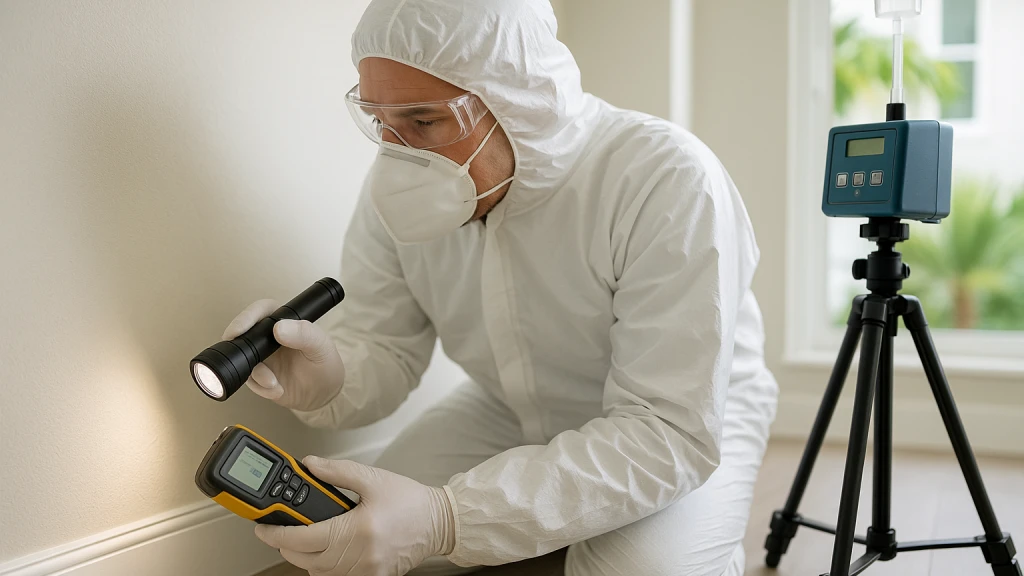
A proper Kissimmee mold inspection is mostly detective work, and only partly lab work. A licensed assessor will typically:
- Walk the home and history — asking about storms, roof age, plumbing, AC service, and any past water events, because the story usually points to the source.
- Read moisture and humidity with meters and a thermo-hygrometer, looking for damp drywall, elevated indoor relative humidity, and cold surfaces where condensation forms.
- Use thermal imaging to spot temperature differences that hint at wet wall cavities, roof leaks, or sweating ductwork without cutting anything open.
- Inspect the air handler and ducts, since in Florida the cooling system itself is one of the most common mold sources and spreads spores room to room.
- Sample only where it helps — air samples (indoor vs. an outdoor baseline) and surface or tape-lift samples sent to an independent lab to identify what's growing and at what levels.
The deliverable should be a written report: where moisture is, what the lab found, a recommended scope of remediation, and the clearance criteria the work has to meet. That report is the document a homeowner, a buyer, or an insurance adjuster can actually act on.
When a Kissimmee homeowner actually needs testing
You don't need a lab report for every musty smell. Testing earns its cost in specific situations: when you smell mold but can't find it; after a roof leak, plumbing leak, or storm-flood event that may have soaked materials you can't see; when buying or selling a home and you want an objective record; when a vacation-rental guest complains and you need documentation; when someone in the home has unexplained respiratory symptoms; and as a clearance test after remediation to confirm the job worked. For a small, obvious patch of mold on a hard surface with a known cause — say, a window sill that sweats — you often don't need testing at all, and an honest inspector will tell you so. Read more in our guide to the signs of mold in a Kissimmee home.
Air sampling vs. surface sampling
People often ask which test they need. Surface (or tape-lift) sampling identifies what a specific visible spot is — useful for confirming whether that dark patch on the bathroom ceiling is Stachybotrys or harmless mildew. Air sampling measures spore concentrations in the air and compares an indoor reading to an outdoor baseline taken the same day; a much higher indoor count, especially of water-damage molds, suggests a hidden active source. Most real inspections use a combination, chosen to answer the specific question at hand rather than running every test by default. Beware anyone who insists on a long, expensive battery of samples before they've even looked at your home.
What inspection and testing cost here
A visual mold inspection of an average Kissimmee home commonly runs in the low-to-mid hundreds of dollars, with lab samples adding roughly $30–$100 each depending on how many and what type. A full assessment with a written report and several samples typically lands somewhere in the few-hundred-dollar range for a single-family home, more for larger or multi-story properties. The value isn't the paperwork — it's avoiding a multi-thousand-dollar remediation you didn't need, or catching one you did before it spreads through the framing. Our cost estimator and Kissimmee cost guide walk through how removal itself is priced once an inspection scopes the work.
From inspection to a dry, healthy home
The point of testing is never the test — it's the decision it lets you make. A clear report tells you whether to do nothing, fix a simple moisture source yourself, or bring in a licensed remediation crew, and it gives that crew a defined target and a clearance standard to hit. If you're not sure whether your situation warrants an inspection, the fastest way to find out is to describe it: tell us what's going on and we'll connect you with a licensed, independent Osceola County assessor for a free, no-pressure conversation about whether testing makes sense for you.