
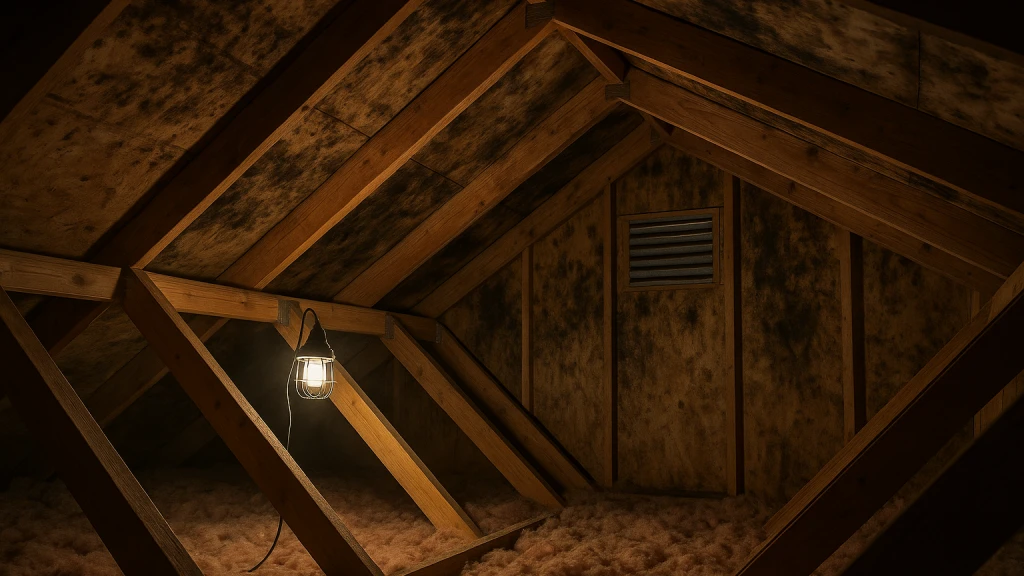
Why Florida attics grow mold
An attic in Central Florida lives at the extremes. Summer attic temperatures can climb past 130°F, and the humid air that fills the space holds enormous amounts of moisture. When that warm, wet air meets any cooler surface — the underside of the roof sheathing at night, a duct carrying cold air — water condenses. Add a roof or flashing leak that lets storm water in, or a bathroom exhaust fan that vents into the attic instead of outside, and you have all three ingredients for mold: moisture, organic material (the plywood roof deck), and warmth. The growth typically appears as gray-to-black staining across the sheathing and along the trusses, often heaviest on the north-facing slope that stays slightly cooler.
What makes attic mold tricky is that it's out of sight and out of mind. Homeowners discover it when a roofer goes up for an estimate, when a home inspector flags it during a sale, or when a musty smell finally migrates down into the living space. By then it has often been growing for a season or more.
The big three causes in Osceola County homes
- Inadequate ventilation: if intake (soffit) and exhaust (ridge or roof vents) aren't balanced, hot humid air stalls in the attic instead of flushing out, and moisture builds against the roof deck.
- Bath and dryer fans venting into the attic: a fan that terminates in the attic instead of through the roof or soffit pumps shower steam and laundry moisture straight into the worst possible space — a shockingly common defect.
- Roof and flashing leaks: storm-driven rain entering around a vent boot, a valley, or aged shingles soaks the sheathing directly, leaving stained, sometimes spongy wood.
Two newer wrinkles show up in Central Florida builds: HVAC ductwork and air handlers installed in the attic, which sweat and leak; and spray-foam or sealed-attic conversions done incorrectly, which can trap moisture if the system isn't designed to manage it.
Insulation, ducts, and what the moisture touches
Attic moisture rarely stays on the roof deck. It soaks into insulation, which then loses its R-value and can harbor growth; it drips onto stored belongings and the top of the ceiling drywall; and it condenses on cold duct surfaces, where it can drip and stain ceilings below. When a homeowner notices a brown spot spreading on a bedroom ceiling with no plumbing above it, the cause is frequently attic condensation or a small roof leak rather than anything in the living space. Tracing that water back to its attic source is the difference between a real fix and repainting the same stain every year.
How attic mold remediation works
Remediating an attic is its own discipline because of the heat, the confined space, and the structural surfaces involved. A licensed crew will generally fix the moisture source first — repairing the roof leak, redirecting bath fans to the outside, or correcting ventilation — because attic mold without a moisture fix always returns. Then they contain and HEPA-filter the work area, remove and replace contaminated insulation, and treat the wood sheathing and framing. On structural wood, professionals often use HEPA vacuuming followed by either an antimicrobial treatment or abrasive methods like soda or dry-ice blasting that strip surface growth from the plywood without removing the wood itself. Finally, they verify dryness and re-establish proper ventilation so the corrected airflow keeps the attic from re-saturating.
Why DIY rarely sticks in an attic
It's tempting to climb up with a spray bottle of bleach, but attic mold resists DIY for predictable reasons. The space is genuinely dangerous to work in — extreme heat, fragile ceiling drywall you can fall through, and poor air to breathe while you stir up spores. Surface-spraying the visible stain does nothing about the ventilation or leak that caused it, so it grows back. And without containment, you push attic spores down into the living space through the attic hatch and any ceiling penetrations. The pros who do this well treat it as a system problem — moisture source, ventilation, insulation, and the wood — not a stain to wipe.
What attic mold removal costs
Attic jobs vary widely. A small, early-stage area with a clear ventilation fix can be a relatively contained project. A fully stained roof deck across a large attic, with contaminated insulation to remove and replace and a roof repair on top, runs into the thousands and occasionally five figures — particularly when insulation replacement and ventilation upgrades are bundled in. Because so much of the cost lives in materials and access rather than the visible mold, an inspection that scopes the true extent is the most reliable way to get an accurate number. Our cost estimator can give you a starting range.
Catching it before it spreads
The cheapest attic mold problem is the one you catch early. If you're having the roof looked at, ask the roofer what the sheathing looks like from below. If you notice a musty smell in upstairs rooms, a ceiling stain with no plumbing above it, or insulation that looks darkened, those are worth investigating before the next humid season makes it worse. Tell us what you're seeing and we'll connect you with a licensed local pro who can assess the attic, find the moisture source, and scope a fix that actually lasts.