First, the practical truth
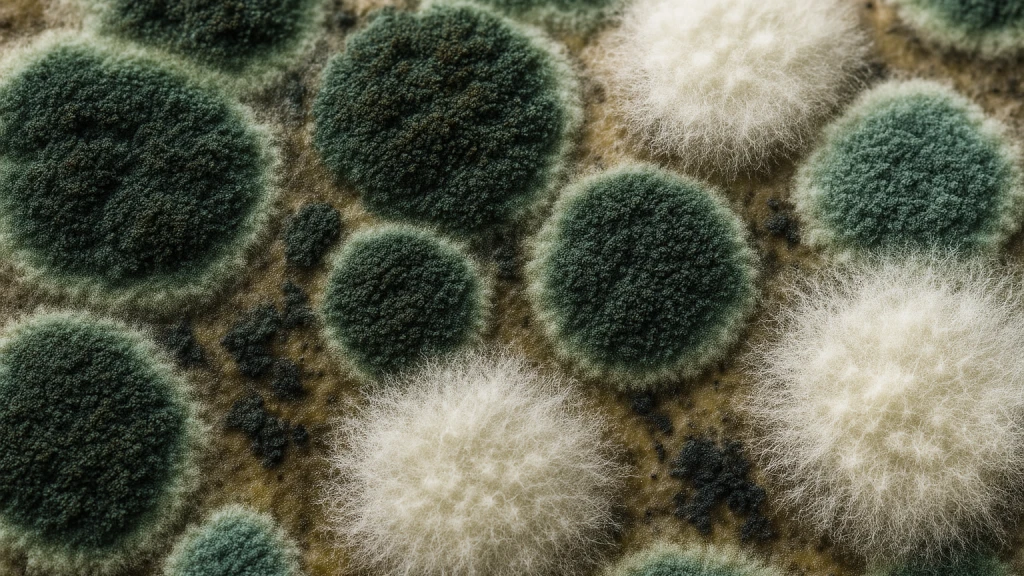
People fixate on identifying the species, but here's what professionals will tell you: for deciding what to do, the type of mold matters less than the fact that it's growing and why. Any visible mold growing indoors indicates a moisture problem, and the response — find the water, contain the area, remove affected porous materials, dry, and verify — is largely the same regardless of species. Identification matters in specific situations: documenting a claim, satisfying a buyer or tenant, or assessing health risk for a sensitive person. But you should never wait on a lab result to address obvious growth, and no homeowner should try to diagnose a species by color alone — many look alike, and only microscopy or culture confirms it. With that framing, here are the molds common in Central Florida homes.
Stachybotrys — 'black mold'
The famous one. Stachybotrys chartarum is dark green to black, often slimy or wet-looking rather than fuzzy, and it grows only where cellulose materials (drywall paper, wood) have stayed wet for days — a sustained leak, not a passing humid spell. It carries a strong musty odor and is the mold most associated with health complaints, which is why it warrants containment-first removal rather than DIY scrubbing. In Kissimmee it typically traces to roof leaks, plumbing leaks, AC condensate overflows, or slab leaks. Our black mold page covers it in detail. Important context: its reputation is somewhat overstated online, but it's still a genuine signal of a serious moisture problem.
Aspergillus and Penicillium
These two are grouped together (often labeled “Asp/Pen” on lab reports) because they're hard to tell apart under a microscope and behave similarly. They're among the most common indoor molds everywhere, including Florida, appearing in many colors — green, blue-green, gray, white, yellow — and growing on a wide range of materials at lower moisture levels than Stachybotrys needs. That lower moisture threshold is why they thrive in humid Florida homes even without a dramatic leak: ambient humidity and condensation are enough. They're common in HVAC systems, on damp walls, and in dust, and some species are significant for people with allergies or compromised immune systems.
Cladosporium and Alternaria
- Cladosporium: one of the most common molds indoors and out, olive-green to brown or black, often appearing as speckled growth on damp surfaces — bathroom walls and tile, around windows, on fabrics, and on cooling-system surfaces. It tolerates a range of conditions and is a frequent allergy trigger.
- Alternaria: dark, woolly or velvety growth that shows up in damp spots like showers, under sinks, and around windows. It's a well-known allergen and one of the molds that drifts in from outdoors and establishes wherever it finds moisture indoors.
The others you might hear about
Lab reports sometimes list molds like Aureobasidium (often pink-to-black, common around windows and on damp wood and caulk), Chaetomium (associated with water-damaged drywall and a musty smell, like Stachybotrys a sign of sustained wetness), and Fusarium (which can grow at cooler temperatures and in water-damaged materials). Each has its quirks, but they share the same headline: they're growing because something is wet. For a Florida homeowner, the catalog of names is less useful than the pattern they all point to.
Why the moisture matters more than the name
The reason professionals de-emphasize species is that the cure is always the same: remove the water. Whatever is growing — black mold on a soaked wall, Asp/Pen blooming from high humidity, Cladosporium speckling a damp bathroom — it cannot survive without moisture, so correcting the moisture source and drying the materials is what actually solves it, with removal of contaminated porous material as needed. Testing has its place for documentation, health assessment, and verifying a cleanup worked, but it's a complement to fixing the moisture, never a substitute. If you've got mold of any color or type in your Kissimmee home, the productive next step isn't guessing the species — it's finding the water. Tell us what you're seeing and we'll connect you with a licensed local pro who can do exactly that.