Why commercial mold is its own challenge
Central Florida's commercial buildings face every residential moisture problem plus a few of their own. Larger HVAC systems and rooftop units move huge volumes of humid air and create condensation across big footprints. Flat commercial roofs pond water and leak at seams and penetrations. Buildings run on schedules that leave them under-cooled at night and on weekends, letting humidity climb. And the tourism economy along the US-192 corridor and around the attractions means a dense stock of hotels, motels, restaurants, and retail — high-traffic, high-moisture buildings where a mold problem can become a guest-facing, review-facing, inspection-facing event fast.
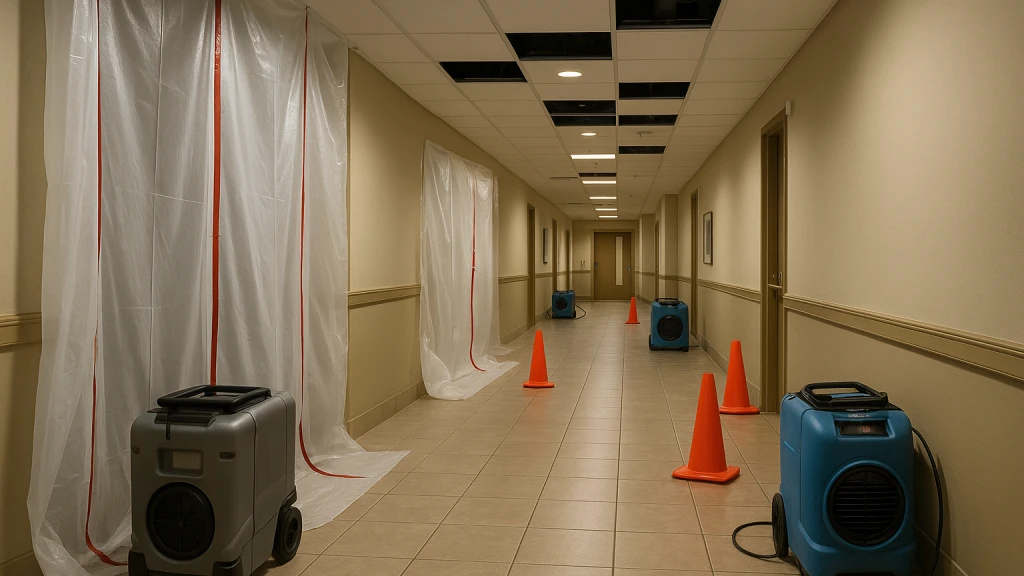
The stakes change the work. A homeowner can live with a contained area sheeted off for a few days. A restaurant, a medical office, or a hotel often can't — which is why commercial remediation leans on after-hours scheduling, phased work that keeps part of the operation running, clean containment that doesn't alarm customers, and documentation that satisfies landlords, insurers, and inspectors.
The buildings we help across Osceola County
- Hotels and motels: guest-room AC units (PTACs) that breed mold, bathroom exhaust issues at scale, and the reputational urgency of a single “musty room” review.
- Restaurants and food service: kitchen humidity, dish-area moisture, walk-in condensation, and health-code exposure that makes fast, documented remediation essential.
- Offices and medical/dental clinics: indoor-air-quality concerns where staff and patients are present, demanding low-disruption, well-contained work.
- Retail and strip centers: roof leaks and shared-wall moisture, often with landlord/tenant questions about who's responsible.
- Property managers and rentals: multi-unit buildings where one unit's leak becomes several units' problem.
Scheduling around your operation
The defining feature of good commercial remediation is that it bends to your business, not the other way around. That can mean working overnight in a restaurant, sectioning a hotel floor so the rest stays bookable, or coordinating with a medical office's patient schedule to keep treatment areas clear. Containment is built to be as unobtrusive as possible, negative-air machines keep spores and odors out of occupied space, and the crew works to a defined clearance so you have proof the space is safe before staff and customers return. For a business, the documentation isn't paperwork — it's the thing that protects you with insurers, landlords, and regulators.
The landlord, tenant, and insurance tangle
Commercial mold almost always comes with a question of responsibility. Is the roof leak the landlord's to fix and the tenant's contents to remediate? Does the lease assign moisture issues to one party? Will the policy treat this as covered sudden damage or excluded long-term seepage? These questions don't change the urgency of stopping the moisture and the growth, but they do make independent assessment and clear documentation especially valuable — a neutral, licensed assessment establishes what happened, what it will take to fix, and what standard the work has to meet, which is exactly what each party needs to sort out who pays. Our overview of Florida mold and insurance touches on the coverage side.
How commercial remediation works
The technical process mirrors residential work — contain, control the moisture source, remove unsalvageable porous materials, treat, dry to a verified standard, and clear — but scaled up and managed around the realities of an operating business. On a commercial job that often means coordinating with HVAC contractors on large rooftop or split systems, roofers on flat-roof repairs, and the building's own maintenance staff; staging work in phases; and producing thorough before-and-after documentation. Because commercial systems move so much air, the HVAC is almost always part of the conversation: a contaminated rooftop unit or duct run will reseed a beautifully remediated space if it's not addressed.
What commercial remediation costs
Commercial pricing depends even more than residential on access, scheduling, and scale. After-hours and phased work, larger square footages, commercial HVAC involvement, and the documentation businesses need all factor in, so projects range widely — from a contained single-area job to a major, multi-zone remediation across a building. The most reliable path to a real number is a licensed commercial assessment that scopes the building and the moisture sources. The cost of remediation almost always compares favorably to the cost of closed doors, failed inspections, or a damaged reputation.
Protecting your business and your name
For a Kissimmee business, the goal is to solve the problem quietly, completely, and on a timeline that keeps you operating. That takes a team experienced with commercial buildings, comfortable working around customers and staff, and disciplined about documentation. Tell us about your property — the type of business, what you're seeing, and your scheduling constraints — and we'll connect you with a licensed, independent local professional who can assess it discreetly and give you a clear, no-pressure plan.